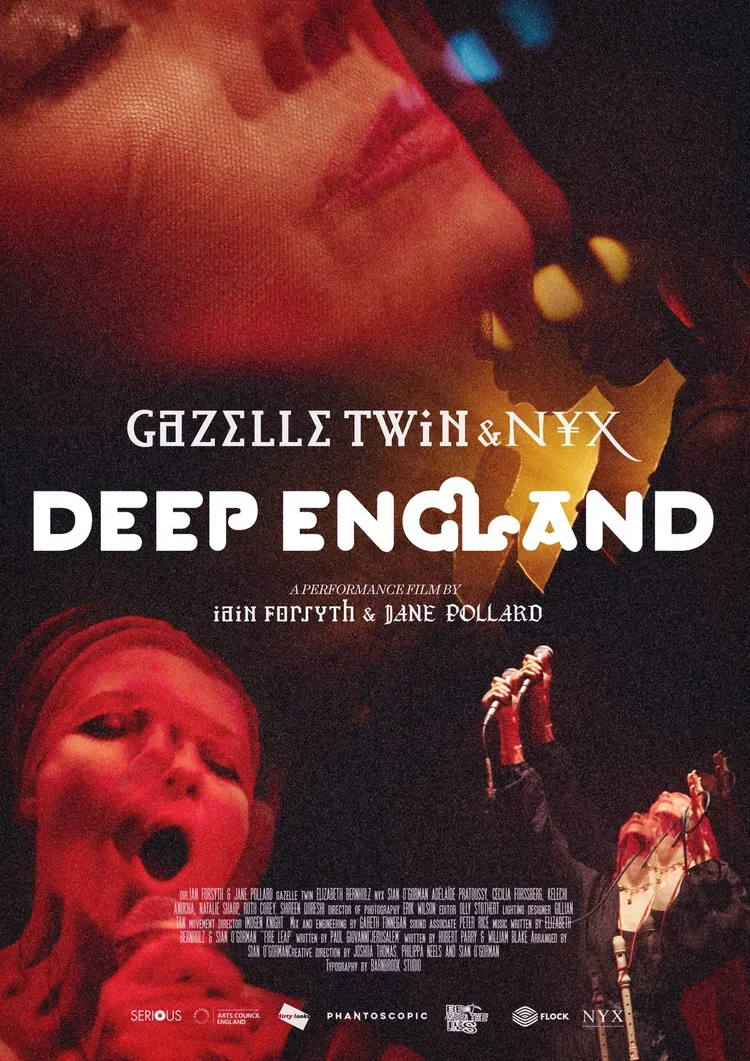
Deep England
NYX and Gazelle Twin gathered at Grade 2 listed building, Shoreditch Town Hall to perform an abridged version of their critically acclaimed album, Deep England. Rooted in English pagan and sacred music, Deep England is an electronic-choral expansion of Gazelle Twin’s 2018 album Pastoral (Anti-Ghost Moon Ray).
Here, tracks from Pastoral, an album whose political themes have only intensified since its original release, are radically reworked and presented alongside music arrangements by NYX Music Director Sian O’Gorman, Paul Giovanni and William Blake. Deep England has been supported by Serious’ Giant Steps, a talent development scheme funded by Help Musicians, Arts Council England, and the Serious Trust.
Curator’s Notes
Deep England was selected for presentation at Rio Cinema because it operates as a work of collective voice and image as much as sound. Originally developed by NYX and Gazelle Twin through live performance in historically charged civic spaces, the project is rooted in English pagan and sacred musical traditions and expands materially on Gazelle Twin’s Pastoral — an album whose political and cultural concerns have only intensified with time.
Rather than functioning as a conventional concert work, Deep England unfolds as a choral–electronic composition shaped by density, repetition, and collective presence. Material from Pastoral is radically reworked and placed alongside new arrangements developed by NYX Music Director Sian O’Gorman, drawing on sources that include Paul Giovanni and William Blake. Voice is treated not as lead or accompaniment, but as a massed, physical element capable of carrying history, tension, and affect without narrative explanation.
Presenting Deep England in a cinema context allows the work to be encountered through focused, seated listening. At Rio Cinema, the screen becomes a surface onto which sound, text, and cultural memory are projected, allowing the audience to experience the work as a shared temporal event rather than a live spectacle. This shift in format foregrounds the project’s internal structure and political resonance, aligning it with The Judgement Hall’s interest in works that ask for sustained attention and collective witness.
In this setting, Deep England is not presented as a document of a past performance, but as a recontextualised encounter — one that brings voice, history, and listening into alignment within the conditions of the cinema.